ASSFN 2026 Meeting Honored Guest Dr. Aviva Abosch Reflects on Her Career
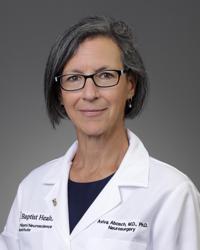
Aviva Abosch, MD, PhD, FAANS is the Honored Guest at the ASSFN 2026 Biennial Meeting, where she will be recognized at a special lunch on Monday, June 1 at 12 PM. For this issue of NeuroPulse, we sat down with Dr. Abosch as a member to spotlight and explore her journey in functional neurosurgery. Read on to learn more about her career and what continues to get her excited about functional neurosurgery.
About Dr. Aviva Abosch
Dr. Aviva Abosch is a distinguished clinician-scientist who holds multiple leadership roles within the field of neurosurgery. Currently, she is the deputy director of the Baptist Health Miami Neuroscience Institute. She is also the director of epilepsy surgery, co-director of functional neurosurgery, and the Esernia Endowed Chair in Surgical Treatment of Adult Epilepsy & Movement Disorders.
Dr. Abosch received her MD and PhD from the University of Pittsburgh. She subsequently completed her neurosurgical residency at the University of California, San Francisco. This is followed by a fellowship in epilepsy surgery at the Montreal Neurological Institute and a fellowship in stereotactic and functional neurosurgery at the University of Toronto.
Dr. Abosch went on to serve as faculty in the Neurosurgery Department at Emory University in Atlanta (2002-2005), and at the University of Minnesota in Minneapolis (2005-2013). From 2013 to 2019, she was a Professor of Neurosurgery, Vice-Chair for Research in the Department of Neurosurgery, and Director of the Epilepsy and Stereotactic Neurosurgery Program at the University of Colorado Anschutz Medical Campus. From 2019-2025, she served as Chair of Neurosurgery at the University of Nebraska Medical Center in Omaha, where she held the Nancy A. Keegan and Donald R. Voelte, Jr. Chair in Neurosurgery.
Q. What inspired you to go into medicine? What, ultimately drove you to neurosurgery?
A. What drove me to neurosurgery was all the wrong reasons. Nobody in my family had ever done it. I come from a family of writers. I liked biological illustration and I got interested in biology, then neuroscience.
If you’re interested in biology, there’s pressure to study premed as an undergraduate, which left me completely cold. I took a year off after university to do research and make sure this is where I was headed.
One of my lab advisors at Rockefeller University said, “You know, if you’re interested in human-subjects research, you should definitely consider getting an MD and a PhD, because otherwise, you’ll always work under a doctor.” I didn’t know if this was true or not. I had no exposure to clinician investigators or PhD-level human-subject researchers. I took that advice and enrolled in the MD and PhD program at the University of Pittsburgh. I absolutely loved what I did in the laboratory. I studied the development of the central nervous system in a mouse model.
I went kicking and screaming back to medical school. In fact, I remember a sit-down meeting with the dean of students who said, “Just get the MD. You won’t regret it. You don’t ever have to practice, but get the degree.”
I went back for my third year of medical school and started with psychiatry. I absolutely loved it!
Temperamentally, this was not for me, although the patients are so compelling from a neuroscientific standpoint. All my mentors in the laboratory were pediatric epilepsy neurologists. I assumed that’s what I was going to do. Pediatric neurology was an early match at that time.
My second rotation of medical school was pediatric epilepsy. It was my neurology rotation that was unbelievably depressing for me. We would get young patients who were completely neurologically devastated. You’d make the diagnosis of an inborn error of metabolism, but there were no therapeutics for those kids.
Consider picking something that’s aligned with your temperament. It suddenly made sense to me why all the pediatric neurologists I knew were in the lab. I had already submitted my applications. The University of Pittsburgh had an expectation that you do two surgical subspecialties in addition to a general surgery rotation. I chose my surgical rotations, which were my electives, because they were adjacent to the nervous system. I chose ophthalmology, which, at the time, I didn’t feel was a good fit for me.
I finally chose neurosurgery. I walked into neurosurgery on my first day of the rotation, and the senior resident handed me the drill. It was the coolest thing ever to me. Then suddenly, after spending my entire doctoral period trying to coax neuronal cultures to live, you’re looking at the surface of the brain. I had an epiphany – this is what I was meant to do. I had already started my pediatric neurology application interviews. At the time, it required two years of pediatrics, then you switched into neurology. From there, you did adult and pediatric neurology with some psychiatry, too.
I remember being at Johns Hopkins and trotting after the pediatric chief resident. He knew I was interested in research, and he talked about having the largest NIH-funded diarrhea study in the entire world at Johns Hopkins. I knew I wouldn’t get through the two years of pediatrics required to be a pediatric neurologist. That, in conjunction with how overwhelmingly amazing neurosurgery was from a practical standpoint, just really grabbed me. It gives you the impression that you are making a difference.
I chose the stereotactic and functional subspecialty within neurosurgery because they were and continue to be at the leading edge of what we do for certain populations of patients. It was interventional neurology to me, and I have never regretted the decision.
What led you to functional neurosurgery and epilepsy surgery?
Back in the 1990s, being a woman in neurosurgery residency or a medical student who had matched in a neurosurgery program, there was a palpable steering into pediatric neurosurgery. There were aspects of pediatric neurosurgery that I thought were compelling and very useful, but that was never for me.
As an undergraduate, my interest in neuroscience came from a curiosity about consciousness. What is it about the brain, the molecules, the genes and the pathways that makes us conscious, aware of our position in the universe, or aware of our own mortality? As far as we know, this is relatively unique in the animal kingdom and perhaps in the universe.
The problem with molecular neuroscience at the time was that it was very reductionist. As an investigator, one would learn more about cell adhesion molecules and pathway-finding of neurons and such, but it didn’t get you any closer to understanding how that collection of individual molecules and gene up-regulation and down-regulation leads to consciousness.
Here’s an example: I engaged in an epilepsy surgery case with Nick Barbaro as a resident. It was an awake case, where the patient was talking, while we were looking at the surface of the brain. This suggested to me that we could get closer as neurosurgeons in stereotactic and functional, which includes epilepsy and awake surgery. It leverages advances in imaging, research imaging, and signal processing to try to figure out how neurons are working as populations, as opposed to individually. This suggested that as neurosurgeons in stereotactic and functional surgery, we could get closer to answering these questions. There have been some astounding advances in the field since I received my training.
Who are your key mentors throughout your career, both in research and in the clinic?
Charlie Wilson was the department chair at UCSF who hired me, during an era of few women in neurosurgery training or clinical practice. He took a gamble and then supported me in my aspirations in ways that I never would have imagined.
I also spent a year training at the Montreal Neurological Institute in epilepsy surgery and epilepsy neurology. The entire group there—the epilepsy neurologists, the neuropsychologists, like Brenda Milner, who is one of the people who worked on H.M., the famous epilepsy patient in whom Wilder Penfield first took out one temporal lobe, then the other, to treat his seizures. They stopped his seizures but ended his declarative memory. The place felt like a living museum. I learned a lot from André Olivier. They were mentors, and they were human. I learned so much from both positive and negative
outcomes.
I learned a great deal through Andrés Lozano at the University of Toronto, and how he approached being a surgeon-scientist, including setting up a stereotactic and functional program.
Importantly, I’ve learned not just from neurosurgeons, but from people at the top of their fields who are pushing boundaries. That continues today. Some of those individuals are earlier in their careers than I am—not necessarily younger in age, but at different stages professionally. There are remarkable people in this field, and there is always something to learn from them.
What are you most excited about clinically and in research right now?
The past 10–15 years in epilepsy have been overwhelming in the best sense. There are far more methods and techniques available now than ever before. Take SEEG, for instance. The old notion that placing a grid over the surface of the brain was sufficient to localize deep-seated seizure onset zones has really been challenged. The brain is an incredibly complex wiring diagram, and electrical activity spreads rapidly along those pathways. I think that led to misinterpretations of where seizures were actually starting, and whether they were best treated with resection versus modulation of the broader
seizure network.
We’re getting much closer to managing epilepsy effectively, but that’s just one piece. There’s LITT as an option for lesions where open resection would risk damaging normal tissue. There’s also RNS—the closest thing we currently have to a closed-loop system for the neurologic disorders we treat in stereotactic and functional neurosurgery. That said, RNS is still reactive; it waits for a seizure to begin and then responds. What would be ideal is something predictive—able to intervene before a seizure starts and prevent it altogether. We’re not there yet, but that’s an incredibly exciting frontier.
People talk a lot about the AI revolution. There are certainly significant ethical concerns, but there is also enormous potential to harness it for the benefit of society, including medicine. Machine-learning algorithms, in particular, have developed rapidly over the past decade and offer powerful tools to move our field forward—whether in prediction, therapeutics, or answering complex research questions. It’s exciting to be part of that moment, to watch it unfold, and to apply it in my own work. We’ll see where it takes us.
As a leader in neurosurgery, what advice do you have for young neurosurgeons who are hoping to advance into leadership roles throughout their careers?
Knowing your own drivers is critical. That requires an honest self-assessment—understanding what motivates you, what you hope to gain from leadership, and what you’re trying to accomplish. There are good reasons and wrong reasons to take on leadership roles, because they come with real opportunity costs. You give something up to step into these positions. And it’s one thing to hold a title; it’s another to actually deliver. If you accumulate titles without delivering, there will eventually be a reckoning.
Assuming you’re motivated by specific goals that leadership can help advance, the best approach is to choose a problem and a role that genuinely resonates with you. You can’t fake that. Whether it’s leadership within a subspecialty—often centered on advocacy for colleagues and patients—or a role in education, you need to find what truly engages you.
Once you’ve identified that, there are many entry points into organized neurosurgery. If you’re drawn to education, that may lead you toward organizations like the Society of Neurological Surgeons (SNS). If your interest lies in stereotactic and functional neurosurgery, the American Society for Stereotactic and Functional Neurosurgery (ASSFN) may be a natural fit. Each society has its own focus and mission, and you have to decide how you want to invest your time and energy—because there are only so many hours in a day.
That said, engagement matters. Even if your primary focus is being a surgeon-scientist and advancing work in the lab, that progress is often supported by others—those serving on committees, working on drug and device policy, and advocating through organizations like the American Association of Neurological Surgeons (AANS), and (Congress of Neurological Surgeons (CNS). These roles enable the broader field to move forward.
It’s not for everyone, but if you choose not to engage, it’s important to recognize that you benefit from the efforts of those who do. Someone must do that work to keep the field advancing.
If you could go back in time, what would you change, about your career, if any?
I’m not sure I regret anything, but I will say that I’ve certainly learned things along the way. I can be a bit hard-headed, but I certainly have made my share of mistakes. I look back on times when I was deeply focused on career objectives, program development, or training residents.
In retrospect, when an obstacle arose, I spent far too much time it and not enough time realizing that it was an opportunity. I have wasted too much emotional valence on things that I could not fix, rather than seeing those challenges as pivotal moments and opportunities in my career.
The upcoming ASSFN meeting is entitled “Bridges of Knowledge.” With this in mind, where do you think our current knowledge gaps are in functional neurosurgery, and how do we begin to bridge those gaps?
We have been dancing around the issue of interfaces now to restore function in many areas: spinal cord injury, epilepsy (to a certain extent), stroke, etc., without really making progress for patients. The field is at a very different place now. Brain-computer interface (BCI) has become a household term, thanks in part to the intense focus by industry on BCI. This has opened spigots for funding. What we’ve learned from signal processing has advanced to a point where there are questions that can now be answered
compared to past practice.
Devices are catching up to what they can actually yield from an implant. If we stay multidisciplinary, collaborative, and focused on patient outcomes, we can actually start to get this out of the lab and available for patient care. It is a very different landscape now from machine-learning and devices standpoint to the investments of industry to solve these problems. I think that we’re going to start to harvest those fruits.
These are exciting times! I could not be more enthusiastic about where things stand today at this point in my career. Making sure that the next generation has everything they need to be successful is a goal of the ASSFN that I fully support.
What are you most looking forward to at the ASSFN 2026 Biennial Meeting?
I am looking forward to the science. It’s one thing to read the publications; it’s another thing to listen to the people responsible for the research and the emphasis they place on the work. It is, without question, the best meeting I attend on a biennial basis. Also, I am completely captivated by the networking opportunities–catching up with colleagues or meeting new ones. This is just as vital as the science that’s being presented, and I am truly looking forward to it.

Justin R Davanzo, MD
Allegheny Health Network
Drexel College of Medicine
In This Issue
Spring 2026
- President’s Welcome: Shaping the Next Frontier at the ASSFN 2026 Biennial Meeting
- Plenaries, Posters, and Progress at ASSFN 2026
- Growing the ASSFN Community with the Associate Membership
- Member Spotlight: Dr. Aviva Abosch Reflects on Her Career
- From Behavior to Brain Science: Dr. Gunvor Kullberg’s Neurosurgical Legacy
- Learning the Latest Techniques & Practices with ASSFN Webinars & Podcasts